Register for Digital Storytelling Panel Discussion on Nov 18!

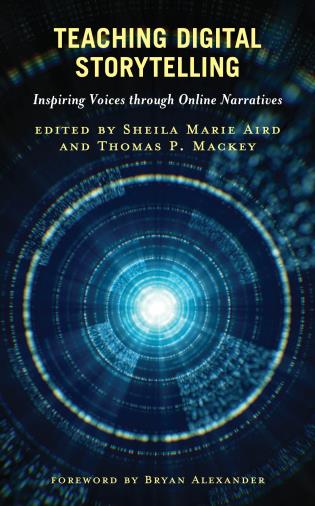
Register today for an engaging conversation with a panel of experts on Monday, November 18, 2024, at 10 AM ET, celebrating the publication of Teaching Digital Storytelling: Inspiring Voices Through Online Narratives by Drs. Sheila Marie Aird and Tom Mackey.

This event, co-hosted by North-West University, South Africa, and Empire State University, USA, will spotlight several authors who contributed to the book recently published by Rowman & Littlefield. They will share their insights and discuss the impact of digital storytelling in global education.
As part of International Education Week (November 18-22), this event will bring together thought leaders from South Africa and the United States to explore how digital storytelling empowers learners and fosters intercultural connections. With a focus on metaliteracy, each author will introduce their chapter, followed by an interactive conversation about the transformative role of digital storytelling in education.

SUNY Empire State University President Lisa Vollendorf, Ph.D. will share a welcome and Prof Dorothy Laubscher, UNESCO Chair on Multimodal Learning and OER, Associate Professor: Self-Directed Learning, Research Unit Self-Directed Learning, Potchefstroom Campus will provide opening remarks. 

Panel Participants:

  • Sheila Marie Aird, Ph.D. and Tom Mackey, Ph.D., from Empire State University will introduce their chapter Metaliteracy and Global Digital Storytelling: Building Shared Learning Communities.
  • Dr. Brenda van Wyk, Ph.D., from the University of Pretoria, South Africa will discuss her chapter Digital Storytelling and Cognitive Justice in Academic Information Services in Southern Africa – A Story Waiting to be Discovered.
  • Beth Carpenter, MLIS, from the State University of New York (SUNY) at Buffalo will explore her chapter The Metaliteracy of Memes: Having Students Track the Flow of Information.
  • Muchativugwa Liberty Hove, Ph.D., from North-West University, South Africa will discuss his chapter Voicing and Agency Through Autoethnography.
  • Logan Rath, Ph.D. and Kathleen Olmstead, Ed.D., from SUNY Brockport will introduce their chapter “It Was Awesome. No One was Telling Us What We Had to Write!”: Empowering Young Writers Through Digital Book Making.
  • Thandiwe Matyobeni, MA, from Rhodes University, South Africa will discuss his chapter Reflections on Digital Storytelling as a Learner-centred Approach to Teaching and Learning in Higher Education Classrooms.

Don’t miss this exciting opportunity to join the conversation and discover how digital storytelling can inspire and connect voices around the world! 
Register here

Exploring Digital Storytelling in Education with Tea for Teaching Podcast

Drs. Sheila Aird and Tom Mackey share insights about digital storytelling on the latest Tea for Teaching podcast. They discuss their book Teaching Digital Storytelling: Inspiring Voices Through Online Narratives.

The co-hosts of this program are John Kane and Rebecca Mushtare. They are from SUNY Oswego and ask a wide range of questions about the book. They also inquired about the Digital Storytelling course at Empire State University that inspired this edited volume.

Digital Storytelling is part of the innovative BA and BS Digital Media Arts program at SUNY Empire. Aird and Mackey teach it as a virtual exchange, connecting students from the United States and Prague.

The podcast features a transcript of the conversation and show notes as well.

Featured Chapter: Poetic Ethnography as Digital Storytelling

By Dr. Kimmika L. H. Williams-Witherspoon

In Anthropology, Theater, performance and Higher Education, one of the legacies of the Covid-19 pandemic was the expanded use of  both fieldwork and virtual performance outcomes to meet the wider pedagogical needs of educational programs. student success, and distribution of research data. The pandemic and its aftermath forced so many of us to rethink what we teach and how we teach and I was fortunate, as an anthropologist teaching in a theater department, “teaching poetic ethnography and ethnographic field research methods that… [resulted] in the creation of global narratives [and] supports and encourages diverse voices” (Williams-Witherspoon, 65). This chapter, critiques the digital storytelling techniques that transformed the Poetic Ethnography course final class projects (2020-2022) that incorporated community engagement strategies, field research and ethnographic research methods to “produce compelling  digital storytelling motifs” (Williams-Witherspoon, 66). Recognizing that performing research “is a constructed process that mediates issues of authenticity, ownership and social activism…This chapter provides a practical toolkit for applying  digital storytelling techniques to a wide range of disciplines and pedagogical settings” (Williams-Witherspoon, 66).

As noted in my chapter:

“Poetic ethnographies encourage students to document and collect memories, reflections and personal narratives by and about neighborhoods and communities. When that data is disseminated through performance and/or digital storytelling, the cultural memories of the communities in question are given greater value and help to recenter the conversation around those communities and their issues.“ (Williams-Witherspoon, 67).

These tips encourage metaliteracy and help to create a new kind of  meta theater that directly reflects a more inclusive “particularizing of place”  and people in and around our communities using various mediums as digital storytelling, [and] resulting in devised performance that recenters marginalized voices and acts as social activist theater” (Williams-Witherspoon, 65). Expanding our understanding of the Toolkit (below), Poetic Ethnography and digital storytelling can be a formidable tool in raising awareness in our communities about the issues, problems and concerns of individuals across multiple positionalities.

Toolkit

Textbox 3.7 Seven Elements of Digital Storytelling (Williams-Witherspoon, 82).

  • Point of View. (What is the main point of the story, dramatic question or author’s perspective?)
  • 3 C’s (Character, Culture, Content) 
  • Logistics: (Form, Length & location)
  • Orality: (Voice, Pitch, Timbre) 
  • Musicality (Rhyme, rhythm & beat) 
  • Multimedia (visuals, images, sound) 
  • Purpose (Historiography, Edutainment, Moral) (Parenti. Make Believe Media. 1992)

___________________________________________________

Williams-Witherspoon, K. (2024). Poetic Ethnography as Digital Storytelling. In Aird and Mackey (Eds.), Teaching Digital Storytelling: Inspiring Voices through Online Narratives. (pp. 65-90). Rowman & Littlefield.

Featured Chapter: Reflections on Digital Storytelling as a Learner-centred Approach to Teaching and Learning in Higher Education Classrooms

By Thandiwe Matyobeni

The chapter “Reflections on Digital Storytelling as a Learner-centred Approach to Teaching and Learning in Higher Education Classrooms” emerged from four years of using digital storytelling in classrooms at Rhodes University. The course is uniquely positioned, having been developed from a Community Engagement division of a university and integrated into credit-bearing curricula across various faculties. In this chapter, I reflect on the successes and challenges experienced in the implementation of this integration, as well as the nuances of the model of storytelling used.

At Rhodes University, social innovation is a form of community engagement, alongside engaged citizenry (volunteerism), engaged research and engaged learning. The digital storytelling course discussed was developed as part of a programme called the Social Innovation Hub. This programme seeks to nurture social cohesion in its environment by supporting social innovation and digital capabilities, and integrating the three pillars of a university.

At first, the course was predominantly used with community members to explore their sense of being and relationship with the city and the university. Gradually, the course gained traction in research spaces, being used as a tool for data collection that places research participants at the helm of the process. Its potential as a tool for teaching and learning soon became evident.

In this chapter, I discuss three cases  to provide an overview of how the method can be adapted to meet various learning objectives.

As noted in the chapter:

“This process supports the development of critical thinking and encourages learners to consider multiple perspectives, reinforcing diversity, equity and inclusion and leading to a deeper understanding of complex issues. By fostering metaliteracy and cognitive reflection, digital storytelling promotes lifelong learning and enables individuals to become active and informed members of society” (Matyobeni, 2024, p. 202).

The stories produced in one of these courses can be viewed here.

“Fresh Off the Boat”

Matyobeni , T.. (2024). Reflections on Digital Storytelling as a Learner-centred Approach to Teaching and Learning in Higher Education Classrooms. In Aird and Mackey (Eds.), Teaching Digital Storytelling: Inspiring Voices through Online Narratives. (pp. 189-208). Rowman & Littlefield.