International Voices in Digital Storytelling Education

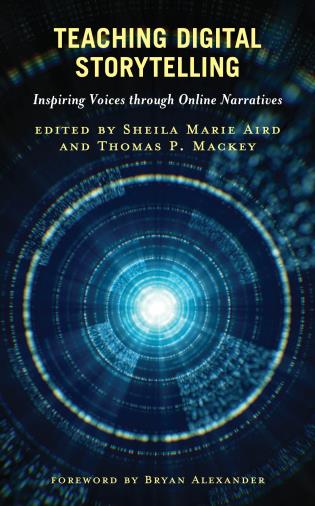
Empire State University, USA, and North-West University, South Africa, facilitated an international conversation Inspiring Global Voices Through Digital Storytelling. This virtual event highlighted several authors who contributed to the book Teaching Digital Storytelling Inspiring Voices Through Online Narratives by Drs. Sheila Aird and Tom Mackey for Rowman & Littlefield.

This engaging conversation brought together thought leaders from South Africa and the United States. They explored how digital storytelling empowers learners. It also fosters intercultural connections. Each author discussed their chapter with a particular focus on metaliteracy. They then engaged in an interactive conversation about the transformative role of digital storytelling in education.

Opening remarks were provided by Empire State University President Lisa Vollendorf, Ph.D. In addition, Prof Dorothy Laubscher also contributed. She is the UNESCO Chair on Multimodal Learning and OER and Associate Professor: Self-Directed Learning, Research Unit Self-Directed Learning, Potchefstroom Campus. 
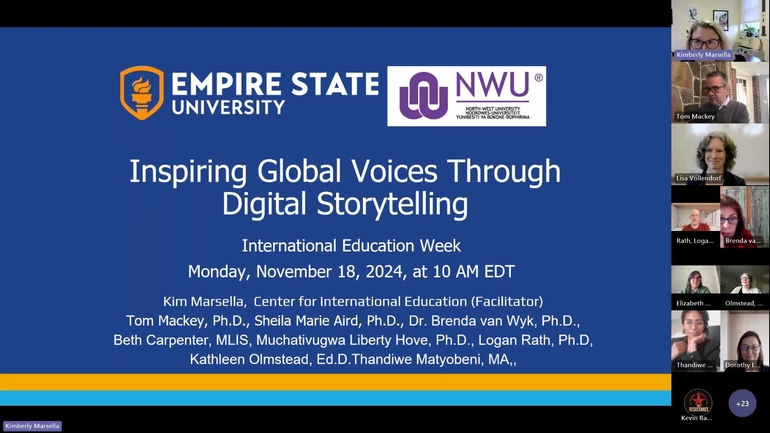
Inspiring Global Voices Through Digital Storytelling

The panel participants for this event included:

  • Sheila Marie Aird, Ph.D. and Tom Mackey, Ph.D., from Empire State University will introduce their chapter Metaliteracy and Global Digital Storytelling: Building Shared Learning Communities.
  • Dr. Brenda van Wyk, Ph.D., from the University of Pretoria, South Africa will discuss her chapter Digital Storytelling and Cognitive Justice in Academic Information Services in Southern Africa – A Story Waiting to be Discovered.
  • Beth Carpenter, MLIS, from the State University of New York (SUNY) at Buffalo will explore her chapter The Metaliteracy of Memes: Having Students Track the Flow of Information.
  • Muchativugwa Liberty Hove, Ph.D., from North-West University, South Africa will discuss his chapter Voicing and Agency Through Autoethnography.
  • Logan Rath, Ph.D. and Kathleen Olmstead, Ed.D., from SUNY Brockport will introduce their chapter “It Was Awesome. No One was Telling Us What We Had to Write!”: Empowering Young Writers Through Digital Book Making.
  • Thandiwe Matyobeni, MA, from Rhodes University, South Africa will discuss his chapter Reflections on Digital Storytelling as a Learner-centred Approach to Teaching and Learning in Higher Education Classrooms.

Register for Digital Storytelling Panel Discussion on Nov 18!

Register today for an engaging conversation with a panel of experts on Monday, November 18, 2024, at 10 AM ET, celebrating the publication of Teaching Digital Storytelling: Inspiring Voices Through Online Narratives by Drs. Sheila Marie Aird and Tom Mackey.

This event, co-hosted by North-West University, South Africa, and Empire State University, USA, will spotlight several authors who contributed to the book recently published by Rowman & Littlefield. They will share their insights and discuss the impact of digital storytelling in global education.

As part of International Education Week (November 18-22), this event will bring together thought leaders from South Africa and the United States to explore how digital storytelling empowers learners and fosters intercultural connections. With a focus on metaliteracy, each author will introduce their chapter, followed by an interactive conversation about the transformative role of digital storytelling in education.

SUNY Empire State University President Lisa Vollendorf, Ph.D. will share a welcome and Prof Dorothy Laubscher, UNESCO Chair on Multimodal Learning and OER, Associate Professor: Self-Directed Learning, Research Unit Self-Directed Learning, Potchefstroom Campus will provide opening remarks. 

Panel Participants:

  • Sheila Marie Aird, Ph.D. and Tom Mackey, Ph.D., from Empire State University will introduce their chapter Metaliteracy and Global Digital Storytelling: Building Shared Learning Communities.
  • Dr. Brenda van Wyk, Ph.D., from the University of Pretoria, South Africa will discuss her chapter Digital Storytelling and Cognitive Justice in Academic Information Services in Southern Africa – A Story Waiting to be Discovered.
  • Beth Carpenter, MLIS, from the State University of New York (SUNY) at Buffalo will explore her chapter The Metaliteracy of Memes: Having Students Track the Flow of Information.
  • Muchativugwa Liberty Hove, Ph.D., from North-West University, South Africa will discuss his chapter Voicing and Agency Through Autoethnography.
  • Logan Rath, Ph.D. and Kathleen Olmstead, Ed.D., from SUNY Brockport will introduce their chapter “It Was Awesome. No One was Telling Us What We Had to Write!”: Empowering Young Writers Through Digital Book Making.
  • Thandiwe Matyobeni, MA, from Rhodes University, South Africa will discuss his chapter Reflections on Digital Storytelling as a Learner-centred Approach to Teaching and Learning in Higher Education Classrooms.

Don’t miss this exciting opportunity to join the conversation and discover how digital storytelling can inspire and connect voices around the world! 
Register here

Exploring Digital Storytelling in Education with Tea for Teaching Podcast

Drs. Sheila Aird and Tom Mackey share insights about digital storytelling on the latest Tea for Teaching podcast. They discuss their book Teaching Digital Storytelling: Inspiring Voices Through Online Narratives.

The co-hosts of this program are John Kane and Rebecca Mushtare. They are from SUNY Oswego and ask a wide range of questions about the book. They also inquired about the Digital Storytelling course at Empire State University that inspired this edited volume.

Digital Storytelling is part of the innovative BA and BS Digital Media Arts program at SUNY Empire. Aird and Mackey teach it as a virtual exchange, connecting students from the United States and Prague.

The podcast features a transcript of the conversation and show notes as well.

Featured Chapter: Reflections on Digital Storytelling as a Learner-centred Approach to Teaching and Learning in Higher Education Classrooms

By Thandiwe Matyobeni

The chapter “Reflections on Digital Storytelling as a Learner-centred Approach to Teaching and Learning in Higher Education Classrooms” emerged from four years of using digital storytelling in classrooms at Rhodes University. The course is uniquely positioned, having been developed from a Community Engagement division of a university and integrated into credit-bearing curricula across various faculties. In this chapter, I reflect on the successes and challenges experienced in the implementation of this integration, as well as the nuances of the model of storytelling used.

At Rhodes University, social innovation is a form of community engagement, alongside engaged citizenry (volunteerism), engaged research and engaged learning. The digital storytelling course discussed was developed as part of a programme called the Social Innovation Hub. This programme seeks to nurture social cohesion in its environment by supporting social innovation and digital capabilities, and integrating the three pillars of a university.

At first, the course was predominantly used with community members to explore their sense of being and relationship with the city and the university. Gradually, the course gained traction in research spaces, being used as a tool for data collection that places research participants at the helm of the process. Its potential as a tool for teaching and learning soon became evident.

In this chapter, I discuss three cases  to provide an overview of how the method can be adapted to meet various learning objectives.

As noted in the chapter:

“This process supports the development of critical thinking and encourages learners to consider multiple perspectives, reinforcing diversity, equity and inclusion and leading to a deeper understanding of complex issues. By fostering metaliteracy and cognitive reflection, digital storytelling promotes lifelong learning and enables individuals to become active and informed members of society” (Matyobeni, 2024, p. 202).

The stories produced in one of these courses can be viewed here.

“Fresh Off the Boat”

Matyobeni , T.. (2024). Reflections on Digital Storytelling as a Learner-centred Approach to Teaching and Learning in Higher Education Classrooms. In Aird and Mackey (Eds.), Teaching Digital Storytelling: Inspiring Voices through Online Narratives. (pp. 189-208). Rowman & Littlefield.

Featured Chapter: Digital Storytelling and Cognitive Justice in Academic Information Services in South Africa – A Story Waiting to be Discovered

By Brenda van Wyk

Storytelling in the African context has a rich history. I rediscovered the joys of storytelling whilst doing research on metaliteracy. I started my career, many moons ago, as a children’s librarian, where storytelling played a huge role. Life’s winding roads came full circle for me when I continued researching literacies and literacy frameworks. This was when I was introduced to the invaluable research on metaliteracy, and its subset of digital storytelling. It did not take much to rekindle my passion, this time in digital format. In this chapter, I report on a study looking at information support services to further the development of self-determined students through a narrative platform capable of crossing many cognitive and metacognitive boundaries and hurdles. The essence of digital storytelling is captured in this quote from my chapter:

“Digital Storytelling is not merely making use of one-directional predesigned videos for online tutorials. It is deeply ethnographical, autoethnographic and participatory… The educational value and strengths of Digital Storytelling manifest in developing cognitive fluency. Cognitive abilities such as critical thinking, reflection, creative problem-solving, and reasoning in an academic learning environment allow for new knowledge creation through immersive experiences for the recipient. Designed correctly, it has the potential to motivate, create interest and increase user engagement for deeper learning. It is a tool that potentially could address the literacy challenges of the South African undergraduate student” (2024, p.56).

Although there is still much work ahead to revive the various affordances of storytelling in South African cases, the study shares the potential value digital storytelling could have in academic information support. In my own teaching experience, I found that students engage easily and remember better when case studies and real-life examples of their theoretical content are shared as digital stories. And this is even more amplified when they are collaboratively creating digital stories.

van Wyk, Brenda (2024). Digital Storytelling and Cognitive Justice in Academic Information Services in South Africa – A Story Waiting to be Discovered. In Aird and Mackey (Eds.), Teaching Digital Storytelling: Inspiring Voices through Online Narratives. (pp. 37-63). Rowman & Littlefield.

Manuscript for Digital Storytelling Book Submitted to Rowman & Littlefield!

We are excited to announce a major milestone in our book project Teaching with Digital Storytelling: Inspiring Voices Through Online Narratives edited by Drs. Sheila Aird and Tom Mackey. Today we submitted the manuscript for this volume to Rowman & Littlefield. Over the next few months we will be working closely with the publisher to finalize the book for an early 2024 publication date. The book will be included in the Innovations in Information Literacy series edited by Trudi E. Jacobson. We are honored that the Foreword for this new book will be written by the digital storytelling pioneer and futurist Bryan Alexander.

The idea for this book emerged from our collaborative work together on designing and teaching an international version of our Digital Storytelling course in the Digital Media Arts at Empire State University. In the same spirit of international partnership, this new volume brings together authors from around the world, and spans universities from South Africa, to the Czech Republic, to the United States. Each of the chapters examines literacy frameworks such as information literacy, metaliteracy, visual literacy, and multiliteracies while also discussing how Diversity, Equity, and Inclusion (DEI) inspires agency and voice in the production of digital narratives.

Here’s a complete listing of all chapter authors for this book:

  • Sheila Marie Aird, PhD, MA, MA – European Director of International Programs for Empire State University and oversees the American delivered programs at the university’s four international locations
  • Beth Carpenter – Student Support and Engagement Librarian at the State University of New York (SUNY) at Buffalo
  • Muchativugwa Liberty Hove – Full Professor in English Language & Literature in English at North-West University, South Africa
  • Thomas P. Mackey, Ph.D. – Professor of Arts and Media and Program Coordinator for the BA and BS Programs in Digital Media Arts at Empire State University.
  • Keith C. Mages – Curator of the Robert L. Brown History of Medicine Collection, a division of the University Libraries at the University at Buffalo, SUNY
  • Michelle Nöthling – Postgraduate Diploma in Gender Studies Master’s Student at University of the Free State, South Africa
  • Kathleen Olmstead EdD – Associate Professor of Literacy at SUNY Brockport
  • Kimberly A. Plassche – Senior Regulatory Consultant at Compliance & Risks, Ltd.,
  • Logan Rath – Instruction and Reference Librarian at SUNY Brockport and a Lecturer at SUNY Albany
  • Deidré van Rooyen – Associate Professor (and Programme Director: Development Studies Programme) for the Centre for Development Support, within Economic and Management Sciences, at the University of the Free State, South Africa
  • Claire S. Schen – Associate Professor of History at the University at Buffalo, SUNY
  • Thandiwe Matyobeni – Programme Coordinator in the Community Engagement division of Rhodes University, South Africa.
  • Kimmika Williams-Witherspoon, PhD (Cultural Anthropology), M.A. (Anthropology), MFA (Theater), Graduate Certificate) Women’s Studies, B.A. (Journalism)- Senior Associate Dean of Strategic Initiatives and Innovation in the Center for the Performing and Cinematic Arts at Temple University and a Full Professor specializing in Urban Theater and Community Engagement in the Theater Department in the School of Theater, Film and Media Arts.
  • Brenda van Wyk – Research Fellow and Senior Lecturer in the Department of Information Science at the University of Pretoria, South Africa.

For a sneak preview of the manuscript, take a look at the attached Table of Contents.

Digital Storytelling Featured as Core Course in New Digital Media Arts Program

Empire State University is launching a new B.A. and B.S. Program in the Digital Media Arts. As part of these two new undergraduate degree options, Digital Storytelling is featured as one of the upper-level core courses.

The international section of Digital Storytelling co-taught by Drs. Sheila Aird and Tom Mackey unites Empire State University students studying in Prague, Czech Republic and the United States. This innovative virtual exchange is for students studying in the Digital Media Arts who are especially interested in gaining international perspectives as part of the program.

As noted in the press release for the two new degrees in the Digital Media Arts:

The program is designed to be flexible, accommodating both full-time and part-time students, as well as transfer students. Employing the “learner as producer” model, students will learn by doing while receiving personalized support and guidance from mentors and faculty with expertise in the field. The duration of the degree program will vary depending on individual course load and prior credits.

https://www.sunyempire.edu/news/releases/2023/empire-state-university-announces-launch-of-new-digital-media-arts-program.php

Drs. Mackey and Aird wrote about the “learner as producer” model that is informed by metaliteracy and central to the new Digital Media Arts Program and the Digital Storytelling course:

This collaborative course creates dialogue among international learners who support each other when providing feedback on individual projects and by working together on a team narrative. The effectiveness of this approach in a fully online COIL course demonstrates that educators need to prepare global learners as both individual and collaborative producers of digital narratives. Metaliteracy is central to this process because it encourages not only the ability to apply digital technologies but to also learn about oneself in connected environments.

https://openpraxis.org/articles/10.55982/openpraxis.13.4.442

The launch of the new Digital Media Arts Program at Empire State University is an exciting development that offers considerable potential to support learners in telling their digital stories with multiple modalities. As a fully online course, Digital Storytelling reinforces these goals while providing opportunities for students to produce and share original narratives with learners from around the world. They develop selfie videos, mobile stories, empowerment stories, and a final collaborative narrative about a social cause.

In addition to Digital Storytelling, the upper-level core requirements also include: Ethics of Digital Art and Design, Information Design, Digital Art & Design: Advanced, History & Theory of New Media, Digital Media Arts, Advanced Drawing, Illustration and Capstone in Digital Media Arts.

Mackey, T. P., & Aird, S. M. (2022). Integrating Metaliteracy into the Design of a Collaborative Online International Learning (COIL) Course in Digital Storytelling. Open Praxis13(4), 397–403. DOI: http://doi.org/10.55982/openpraxis.13.4.442

Digital Storytelling Presentation at ICIL 2022 in South Africa

The 2nd Annual International Conference on Information Literacy (ICIL 2022) at North West University (NWU) in South Africa featured a virtual presentation by Dr. Sheila Aird and Dr. Tom Mackey entitled Virtual Exchange: Developing Global Digital Narratives and Metaliteracy in a Shared Learning Community. This presentation explores the fully online Digital Storytelling course that Drs. Aird and Mackey teach at SUNY Empire State College as a virtual exchange primarily between Prague, Czech Republic and the United States. Here’s a video of the presentation recorded in advance of the conference (we will share the version that was recorded live with questions from participants if it becomes available).

To learn more about this international collaboration explore the article published by Drs. Aird and Mackey in Open Praxis: 

Mackey, T. P., & Aird, S. M. (2022). Integrating Metaliteracy into the Design of a Collaborative Online International Learning (COIL) Course in Digital Storytelling. Open Praxis13(4), 397–403. DOI: http://doi.org/10.55982/openpraxis.13.4.442

Designing an Online Learning Community to Create Global Digital Stories

The international collaboration established by Dr. Sheila Marie Aird and Dr. Thomas P. Mackey to co-teach Digital Storytelling at SUNY Empire State College was featured at the 4th International Research Conference 2022 (AUEIRC) on May 22, 2022.  As part of their collaborative presentation, Drs. Aird and Mackey discussed a new proceedings paper they co-authored entitled Designing an Online Learning Community to Create Global Digital Stories. The theme of this year’s conference is Future of Digital Transformation: Technology, Innovation, and Creativity. This virtual event is sponsored by the American University in the Emirates in the United Arab Emirates (UAE) and the International Higher Education Teaching & Learning Association (HETL). The entire program for the three-day conference is available online at the AUEIRC web site.

Digital Transformation Conference at the UAE Features Digital Storytelling

Dr. Sheila Marie Aird and Dr. Thomas P. Mackey will present a new proceedings paper entitled “Designing an Online Learning Community to Create Global Digital Stories” at the 4th International Research Conference 2022. Their presentation takes place virtually on Sunday, May 22 (15:00-15:30 GST / 7am EST / 1pm CET).

The event is sponsored by the American University in the Emirates in the United Arab Emirates (UAE) and the International Higher Education Teaching & Learning Association (HETL). This year’s conference theme is Future of Digital Transformation: Technology, Innovation, and Creativity and the entire program is now available online. According to the abstract for Sheila and Tom’s paper:

The integration of metaliteracy into an online course about digital storytelling supports the innovative design of a global learning community. This collaborative online international learning (COIL) course is focused on building a shared virtual space for team-based teaching and learning. This process involves engaging learners in course materials, such as digital media tools, interactive learning objectives, grading rubrics, and open educational resources (OER). Students participate in the Moodle Learning Management System (LMS) to actively participate in asynchronous discussions, a structured peer review process, and team planning that reinforces creativity and project management in the design and implementation of digital media projects.

(Aird & Mackey, 2022)

This new paper is based on the international collaboration established by Drs. Aird and Mackey to co-teach students from Europe and the United States. As part of their work together, they have been team-teaching Digital Storytelling as a Collaborative Online International Learning (COIL) course for over two years at SUNY Empire State College.