by Muchativugwa Liberty Hove
We welcome this guest blog post from Muchativugwa Liberty Hove, Full Professor in English Language & Literature in English at North-West University and formerly a Postdoctoral Research Fellow, University of Limpopo, South Africa. The author provides a summary of his chapter Voicing Agency through Ethnography from our new book Teaching Digital Storytelling: Inspiring Voices Through Online Narratives.
“Voicing agency through ethnography” evolved from documentary viewing, reading and writing about Dovie and Sissay, agents/voices who had experienced traumatic colonial assault on their identities and processes of becoming (https://vimeo.com/193972360). In the demographic and cultural crises prompted by this trauma, I strove to engage the agents/voices as they revived and re-invented politically contested and historically unfinished, culturally nuanced interpretations that approximated styles of proximation and distancing. Each of the autoethnographies questioned: who has the author/ity to speak for a group’s being, identity or authenticity? What narrative strategies privilege development, loss and innovation to account for oppositional narratives? In this predicament of autoethnography, different histories must be laminated to local futures.
As noted in my chapter:
In operationalizing critical theory, this chapter contends that multiliteracies is a specific pedagogical framework for rethinking the future of storytelling, language, and literature education within the context of major social and technological changes. The global and glocal compel communication in an ever-evolving English language, where technological, linguistic, and cultural change demand new and versatile forms of global citizenship. Dovie’s narrative illustrates that there are multiple literacies produced through autoethnography and digital storytelling. Multiliteracies assume multiple worlds connected in multiple ways, deliberately fashioned to inaugurate new identities and agency (Hove, 91).
Muchativugwa Liberty Hove
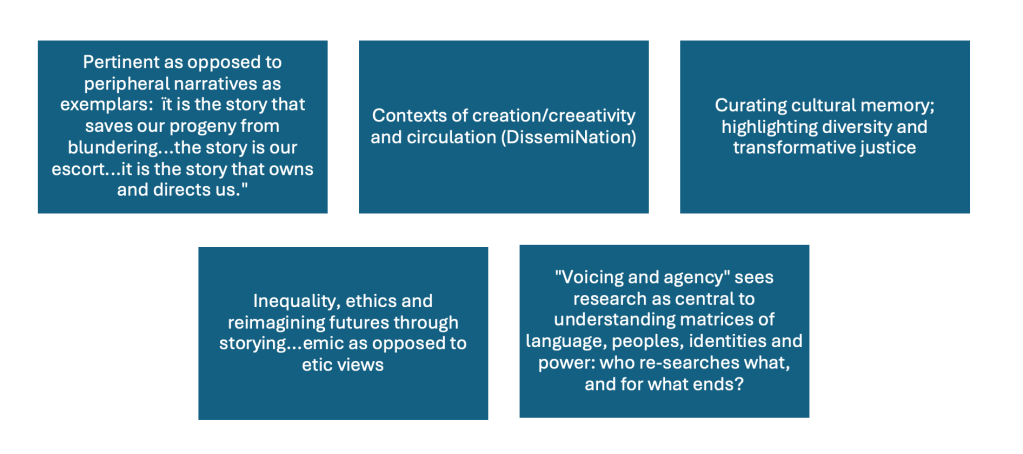
This diagram literally condenses my chapter into a conceptual flow map:
-Muchativugwa Liberty Hove (2024) ORCID: https://orcid.org/0000-0002-6021-4639.
We look forward to featuring more of our exceptional authors in the near future! To learn more about our new book and how to obtain a copy, download this flyer! – Sheila and Tom
Hove, M.L. (2024). Voicing Agency through Ethnography. In Aird and Mackey (Eds.), Teaching Digital Storytelling: Inspiring Voices through Online Narratives. (pp. 91-106). Rowman & Littlefield.
 Global Digital Stories
You must be logged in to post a comment.