Register for Digital Storytelling Panel Discussion on Nov 18!

Register today for an engaging conversation with a panel of experts on Monday, November 18, 2024, at 10 AM ET, celebrating the publication of Teaching Digital Storytelling: Inspiring Voices Through Online Narratives by Drs. Sheila Marie Aird and Tom Mackey.

This event, co-hosted by North-West University, South Africa, and Empire State University, USA, will spotlight several authors who contributed to the book recently published by Rowman & Littlefield. They will share their insights and discuss the impact of digital storytelling in global education.
As part of International Education Week (November 18-22), this event will bring together thought leaders from South Africa and the United States to explore how digital storytelling empowers learners and fosters intercultural connections. With a focus on metaliteracy, each author will introduce their chapter, followed by an interactive conversation about the transformative role of digital storytelling in education.

SUNY Empire State University President Lisa Vollendorf, Ph.D. will share a welcome and Prof Dorothy Laubscher, UNESCO Chair on Multimodal Learning and OER, Associate Professor: Self-Directed Learning, Research Unit Self-Directed Learning, Potchefstroom Campus will provide opening remarks. 

Panel Participants:

  • Sheila Marie Aird, Ph.D. and Tom Mackey, Ph.D., from Empire State University will introduce their chapter Metaliteracy and Global Digital Storytelling: Building Shared Learning Communities.
  • Dr. Brenda van Wyk, Ph.D., from the University of Pretoria, South Africa will discuss her chapter Digital Storytelling and Cognitive Justice in Academic Information Services in Southern Africa – A Story Waiting to be Discovered.
  • Beth Carpenter, MLIS, from the State University of New York (SUNY) at Buffalo will explore her chapter The Metaliteracy of Memes: Having Students Track the Flow of Information.
  • Muchativugwa Liberty Hove, Ph.D., from North-West University, South Africa will discuss his chapter Voicing and Agency Through Autoethnography.
  • Logan Rath, Ph.D. and Kathleen Olmstead, Ed.D., from SUNY Brockport will introduce their chapter “It Was Awesome. No One was Telling Us What We Had to Write!”: Empowering Young Writers Through Digital Book Making.
  • Thandiwe Matyobeni, MA, from Rhodes University, South Africa will discuss his chapter Reflections on Digital Storytelling as a Learner-centred Approach to Teaching and Learning in Higher Education Classrooms.

Don’t miss this exciting opportunity to join the conversation and discover how digital storytelling can inspire and connect voices around the world! 
Register here
Featured Chapter: Voicing Agency through Ethnography

by Muchativugwa Liberty Hove

“Voicing agency through ethnography” evolved from documentary viewing, reading and writing about Dovie and Sissay, agents/voices who had experienced traumatic colonial assault on their identities and processes of becoming (https://vimeo.com/193972360). In the demographic and cultural crises prompted by this trauma, I strove to engage the agents/voices as they revived and re-invented politically contested and historically unfinished, culturally nuanced interpretations that approximated styles of proximation and distancing. Each of the autoethnographies questioned: who has the author/ity to speak for a group’s being, identity or authenticity? What narrative strategies privilege development, loss and innovation to account for oppositional narratives? In this predicament of autoethnography, different histories must be laminated to local futures.

As noted in my chapter:

In operationalizing critical theory, this chapter contends that multiliteracies is a specific pedagogical framework for rethinking the future of storytelling, language, and literature education within the context of major social and technological changes. The global and glocal compel communication in an ever-evolving English language, where technological, linguistic, and cultural change demand new and versatile forms of global citizenship. Dovie’s narrative illustrates that there are multiple literacies produced through autoethnography and digital storytelling. Multiliteracies assume multiple worlds connected in multiple ways, deliberately fashioned to inaugurate new identities and agency (Hove, 91).

Muchativugwa Liberty Hove

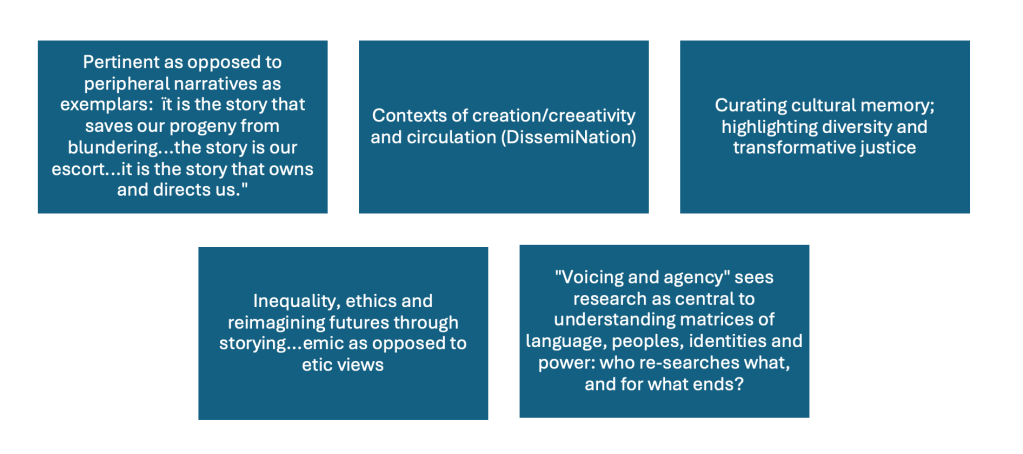
This diagram literally condenses my chapter into a conceptual flow map:

-Muchativugwa Liberty Hove (2024) ORCID: https://orcid.org/0000-0002-6021-4639.

Hove, M.L. (2024). Voicing Agency through Ethnography. In Aird and Mackey (Eds.), Teaching Digital Storytelling: Inspiring Voices through Online Narratives. (pp. 91-106). Rowman & Littlefield.

Manuscript for Digital Storytelling Book Submitted to Rowman & Littlefield!

We are excited to announce a major milestone in our book project Teaching with Digital Storytelling: Inspiring Voices Through Online Narratives edited by Drs. Sheila Aird and Tom Mackey. Today we submitted the manuscript for this volume to Rowman & Littlefield. Over the next few months we will be working closely with the publisher to finalize the book for an early 2024 publication date. The book will be included in the Innovations in Information Literacy series edited by Trudi E. Jacobson. We are honored that the Foreword for this new book will be written by the digital storytelling pioneer and futurist Bryan Alexander.

The idea for this book emerged from our collaborative work together on designing and teaching an international version of our Digital Storytelling course in the Digital Media Arts at Empire State University. In the same spirit of international partnership, this new volume brings together authors from around the world, and spans universities from South Africa, to the Czech Republic, to the United States. Each of the chapters examines literacy frameworks such as information literacy, metaliteracy, visual literacy, and multiliteracies while also discussing how Diversity, Equity, and Inclusion (DEI) inspires agency and voice in the production of digital narratives.

Here’s a complete listing of all chapter authors for this book:

  • Sheila Marie Aird, PhD, MA, MA – European Director of International Programs for Empire State University and oversees the American delivered programs at the university’s four international locations
  • Beth Carpenter – Student Support and Engagement Librarian at the State University of New York (SUNY) at Buffalo
  • Muchativugwa Liberty Hove – Full Professor in English Language & Literature in English at North-West University, South Africa
  • Thomas P. Mackey, Ph.D. – Professor of Arts and Media and Program Coordinator for the BA and BS Programs in Digital Media Arts at Empire State University.
  • Keith C. Mages – Curator of the Robert L. Brown History of Medicine Collection, a division of the University Libraries at the University at Buffalo, SUNY
  • Michelle Nöthling – Postgraduate Diploma in Gender Studies Master’s Student at University of the Free State, South Africa
  • Kathleen Olmstead EdD – Associate Professor of Literacy at SUNY Brockport
  • Kimberly A. Plassche – Senior Regulatory Consultant at Compliance & Risks, Ltd.,
  • Logan Rath – Instruction and Reference Librarian at SUNY Brockport and a Lecturer at SUNY Albany
  • Deidré van Rooyen – Associate Professor (and Programme Director: Development Studies Programme) for the Centre for Development Support, within Economic and Management Sciences, at the University of the Free State, South Africa
  • Claire S. Schen – Associate Professor of History at the University at Buffalo, SUNY
  • Thandiwe Matyobeni – Programme Coordinator in the Community Engagement division of Rhodes University, South Africa.
  • Kimmika Williams-Witherspoon, PhD (Cultural Anthropology), M.A. (Anthropology), MFA (Theater), Graduate Certificate) Women’s Studies, B.A. (Journalism)- Senior Associate Dean of Strategic Initiatives and Innovation in the Center for the Performing and Cinematic Arts at Temple University and a Full Professor specializing in Urban Theater and Community Engagement in the Theater Department in the School of Theater, Film and Media Arts.
  • Brenda van Wyk – Research Fellow and Senior Lecturer in the Department of Information Science at the University of Pretoria, South Africa.

For a sneak preview of the manuscript, take a look at the attached Table of Contents.

Creating a Global Learning Community Through Digital Storytelling

Digital Storytelling is featured this year at the University Global Coalition Virtual Gathering that takes place September 27-28, 2021. Dr. Sheila Marie Aird, Associate Professor, European Director of International Programs and Dr. Thomas P. Mackey, Professor of Arts and Media, both at SUNY Empire State College, present on their international collaboration during the session Creating a Global Learning Community Through Digital Storytelling. According to the abstract for this presentation:

Teaching and learning the art of digital storytelling creates a global learning community that supports the United Nations’ Sustainable Development Goals. Co-teaching a fully online course on digital storytelling at SUNY Empire State College brings together students from the United States, Canada, Czech Republic, and Albania, in a model that others can learn from and adapt for their institutions. As part of this learning experience, students develop individual digital narratives about such themes as mobility and empowerment. They also produce a culminating collaborative digital story about a specific cause that they research and advocate for as a team. Team story topics have included racism and social justice, COVID-19 and pandemic art, and Violence Against Asians.

This interactive presentation will feature both a survey and padlet to engage with the audience during the talk. The slide deck is available with an overview of ideas and digital storytelling resources.

If you have any questions about our presentation or would like to learn more about our approach to teaching Digital Storytelling, feel free to reach out to us!

-Tom and Sheila

Building Empowered Communities with Digital Storytelling

As we continue teaching our fully online Digital Storytelling course as an international collaboration, we share our latest reflections and insights as part of our zoom recording. Although this was recorded for our course, it provides you with a unique perspective on where we are in the class, how we are teaching it, and what we value as co-teachers in this environment. In this week’s Zoom dialogue we talk about the importance of building a collaborative online community, encourage learners to find their voices in the online discussions, and explore the importance of digital ethics when producing information as a digital storyteller! If you are an experienced online instructor, new to online, multimodal, or remote learning, or if your are interested in teaching digital storytelling, we hope you enjoy our latest conversation as much as we did!

(click on the image to see the video)