by Beth Carpenter
We welcome this guest post from Beth Carpenter, student support and engagement librarian at the State University of New York (SUNY) at Buffalo, who writes about her chapter “The Metaliteracy of Memes: Having Students Track the Flow of Information” from our book Teaching Digital Storytelling: Inspiring Voices Through Online Narratives.
Social media holds a great deal of power in the world today. So many people around the country, around the globe, log onto some sort of social media every day. As more information and more knowledge becomes accessible, it means that the ability to connect over common experiences lessens. Memes and online jokes feel like two of the ways to create connections, across culture and generation.
It is exciting to think about “The Metaliteracy of Memes,” and reflecting on the levels of understanding that are required to get some of the jokes that float around X/Twitter, Instagram, TikTok, and other social media platforms. It means that the students we encounter in the classroom are able to navigate this multi-layered language that exists on the internet. As discussed in my chapter, metaliteracy deepens their inherent research skills that they are able to bring to bear on academic assignments.
It can be hard to feel like there’s a pressure to stay up to date on the latest trends going around social media, but as stated in my chapter, “Taking memes and online jokes and bringing them into the classroom is one way to make not only the library space feel accessible but the concepts being taught feel accessible. Students should not be scared to follow their interests, and to allow those interests to inform their research” (Carpenter, p. 142).
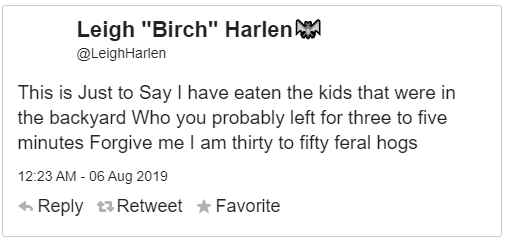
This tweet exemplifies the metaliteracy of memes – almost impossible to understand the joke unless you were aware of the 30-50 feral hog meme on Twitter in 2019, and familiar with “This Is Just To Say” by William Carlos Williams, and how it is used as a meme format on the social media platform. Multiple layers of meaning all at once give depth to the meme, layers to understanding, and cultural context.
Beth Carpenter is a student support and engagement librarian at the State University of New York (SUNY) at Buffalo. She works primarily with undergraduate information literacy education, and her research and teaching are focused on the intersection of pop culture, social media, and information literacy. When she’s not spending time on the internet, she’s thinking about ways to dismantle structural inequities in academia.
Carpenter, Beth (2024). The Metaliteracy of Memes: Having Students Track the Flow of Information. In Aird and Mackey (Eds.), Teaching Digital Storytelling: Inspiring Voices through Online Narratives. (pp. 129-148). Rowman & Littlefield.
 Global Digital Stories
You must be logged in to post a comment.