International Voices in Digital Storytelling Education

Empire State University, USA, and North-West University, South Africa, facilitated an international conversation Inspiring Global Voices Through Digital Storytelling. This virtual event highlighted several authors who contributed to the book Teaching Digital Storytelling Inspiring Voices Through Online Narratives by Drs. Sheila Aird and Tom Mackey for Rowman & Littlefield.

This engaging conversation brought together thought leaders from South Africa and the United States. They explored how digital storytelling empowers learners. It also fosters intercultural connections. Each author discussed their chapter with a particular focus on metaliteracy. They then engaged in an interactive conversation about the transformative role of digital storytelling in education.

Opening remarks were provided by Empire State University President Lisa Vollendorf, Ph.D. In addition, Prof Dorothy Laubscher also contributed. She is the UNESCO Chair on Multimodal Learning and OER and Associate Professor: Self-Directed Learning, Research Unit Self-Directed Learning, Potchefstroom Campus. 
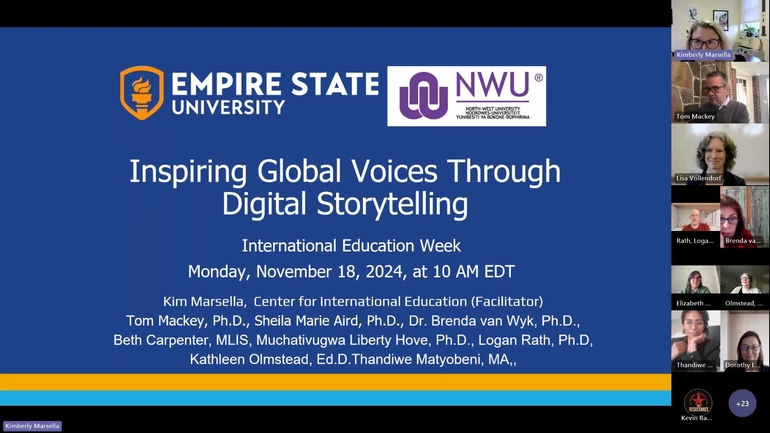
Inspiring Global Voices Through Digital Storytelling

The panel participants for this event included:

  • Sheila Marie Aird, Ph.D. and Tom Mackey, Ph.D., from Empire State University will introduce their chapter Metaliteracy and Global Digital Storytelling: Building Shared Learning Communities.
  • Dr. Brenda van Wyk, Ph.D., from the University of Pretoria, South Africa will discuss her chapter Digital Storytelling and Cognitive Justice in Academic Information Services in Southern Africa – A Story Waiting to be Discovered.
  • Beth Carpenter, MLIS, from the State University of New York (SUNY) at Buffalo will explore her chapter The Metaliteracy of Memes: Having Students Track the Flow of Information.
  • Muchativugwa Liberty Hove, Ph.D., from North-West University, South Africa will discuss his chapter Voicing and Agency Through Autoethnography.
  • Logan Rath, Ph.D. and Kathleen Olmstead, Ed.D., from SUNY Brockport will introduce their chapter “It Was Awesome. No One was Telling Us What We Had to Write!”: Empowering Young Writers Through Digital Book Making.
  • Thandiwe Matyobeni, MA, from Rhodes University, South Africa will discuss his chapter Reflections on Digital Storytelling as a Learner-centred Approach to Teaching and Learning in Higher Education Classrooms.
Featured Chapter: Digital Storytelling and Cognitive Justice in Academic Information Services in South Africa – A Story Waiting to be Discovered

By Brenda van Wyk

Storytelling in the African context has a rich history. I rediscovered the joys of storytelling whilst doing research on metaliteracy. I started my career, many moons ago, as a children’s librarian, where storytelling played a huge role. Life’s winding roads came full circle for me when I continued researching literacies and literacy frameworks. This was when I was introduced to the invaluable research on metaliteracy, and its subset of digital storytelling. It did not take much to rekindle my passion, this time in digital format. In this chapter, I report on a study looking at information support services to further the development of self-determined students through a narrative platform capable of crossing many cognitive and metacognitive boundaries and hurdles. The essence of digital storytelling is captured in this quote from my chapter:

“Digital Storytelling is not merely making use of one-directional predesigned videos for online tutorials. It is deeply ethnographical, autoethnographic and participatory… The educational value and strengths of Digital Storytelling manifest in developing cognitive fluency. Cognitive abilities such as critical thinking, reflection, creative problem-solving, and reasoning in an academic learning environment allow for new knowledge creation through immersive experiences for the recipient. Designed correctly, it has the potential to motivate, create interest and increase user engagement for deeper learning. It is a tool that potentially could address the literacy challenges of the South African undergraduate student” (2024, p.56).

Although there is still much work ahead to revive the various affordances of storytelling in South African cases, the study shares the potential value digital storytelling could have in academic information support. In my own teaching experience, I found that students engage easily and remember better when case studies and real-life examples of their theoretical content are shared as digital stories. And this is even more amplified when they are collaboratively creating digital stories.

van Wyk, Brenda (2024). Digital Storytelling and Cognitive Justice in Academic Information Services in South Africa – A Story Waiting to be Discovered. In Aird and Mackey (Eds.), Teaching Digital Storytelling: Inspiring Voices through Online Narratives. (pp. 37-63). Rowman & Littlefield.

Featured Chapter: The Metaliteracy of Memes

by Beth Carpenter

Social media holds a great deal of power in the world today. So many people around the country, around the globe, log onto some sort of social media every day. As more information and more knowledge becomes accessible, it means that the ability to connect over common experiences lessens. Memes and online jokes feel like two of the ways to create connections, across culture and generation.

It is exciting to think about “The Metaliteracy of Memes,” and reflecting on the levels of understanding that are required to get some of the jokes that float around X/Twitter, Instagram, TikTok, and other social media platforms. It means that the students we encounter in the classroom are able to navigate this multi-layered language that exists on the internet. As discussed in my chapter, metaliteracy deepens their inherent research skills that they are able to bring to bear on academic assignments.

It can be hard to feel like there’s a pressure to stay up to date on the latest trends going around social media, but as stated in my chapter, “Taking memes and online jokes and bringing them into the classroom is one way to make not only the library space feel accessible but the concepts being taught feel accessible. Students should not be scared to follow their interests, and to allow those interests to inform their research” (Carpenter, p. 142).

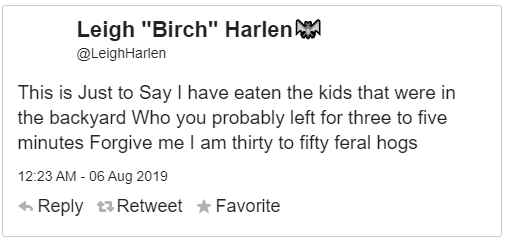
This tweet exemplifies the metaliteracy of memes – almost impossible to understand the joke unless you were aware of the 30-50 feral hog meme on Twitter in 2019, and familiar with “This Is Just To Say” by William Carlos Williams, and how it is used as a meme format on the social media platform. Multiple layers of meaning all at once give depth to the meme, layers to understanding, and cultural context.

Carpenter, Beth (2024). The Metaliteracy of Memes: Having Students Track the Flow of Information. In Aird and Mackey (Eds.), Teaching Digital Storytelling: Inspiring Voices through Online Narratives. (pp. 129-148). Rowman & Littlefield.